
About This Event
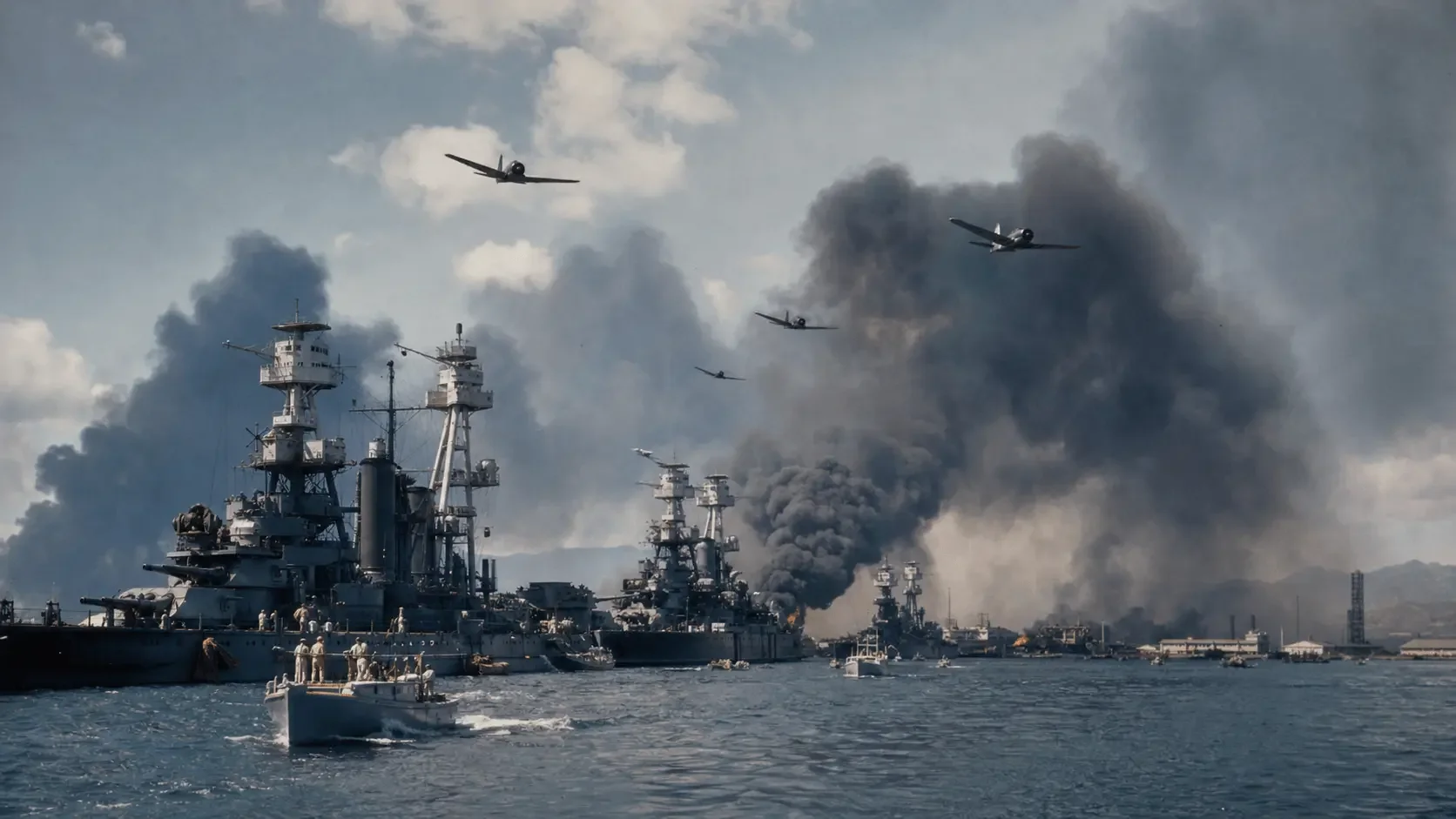
The attack on Pearl Harbor took place on the morning of December 7, 1941, after years of worsening relations between the United States and Japan. Japan’s war in China and expansion into French Indochina brought increasingly severe U.S. economic restrictions, including measures that limited access to oil and other strategic materials. Diplomatic negotiations continued through 1941, but Japanese leaders also prepared a wider offensive across the Pacific and Southeast Asia. A central objective was to damage the U.S. Pacific Fleet at Pearl Harbor, Hawaiʻi, so that American naval power could not quickly interfere with those operations.
Six Japanese aircraft carriers approached Hawaiʻi undetected and launched two waves of aircraft. The first attack reached Oʻahu shortly before 8:00 a.m., striking Pearl Harbor and nearby military airfields including Hickam and Wheeler. Battleships moored along Ford Island became major targets. USS Arizona exploded after a bomb penetrated near its forward magazines, killing 1,177 crewmen, while USS Oklahoma capsized after torpedo hits. Other battleships, cruisers, destroyers, support vessels, and aircraft were damaged or destroyed. American service members fought back under chaotic conditions; among those later recognized for bravery was mess attendant Doris “Dorie” Miller, who helped wounded sailors and fired an antiaircraft weapon despite having no formal training on it.
Official Navy and Department of Defense accounts record 2,403 Americans killed and 1,178 wounded. Twenty-one U.S. ships were sunk or damaged, and 188 aircraft were destroyed. The attack inflicted severe losses, but several strategically important assets survived: the Pacific Fleet’s aircraft carriers were not in port, and vital repair facilities and fuel storage were largely left intact. Japan’s forces withdrew after the second wave rather than attempting an invasion of Hawaiʻi.
On December 8, President Franklin D. Roosevelt asked Congress for a declaration of war, describing December 7 as a “date which will live in infamy.” Congress declared war on Japan that day; Germany and Italy declared war on the United States on December 11, bringing the country fully into World War II. Pearl Harbor ended the remaining political debate over whether the United States would enter the war and triggered enormous military and industrial mobilization. It also intensified fear and anti-Japanese racism, which the federal government soon translated into policies that culminated in the incarceration of Japanese Americans. At Pearl Harbor National Memorial today, the USS Arizona Memorial, USS Oklahoma Memorial, Ford Island, and museum exhibits preserve the physical setting of the attack and commemorate those who were killed.
Last updated August 13, 2026