
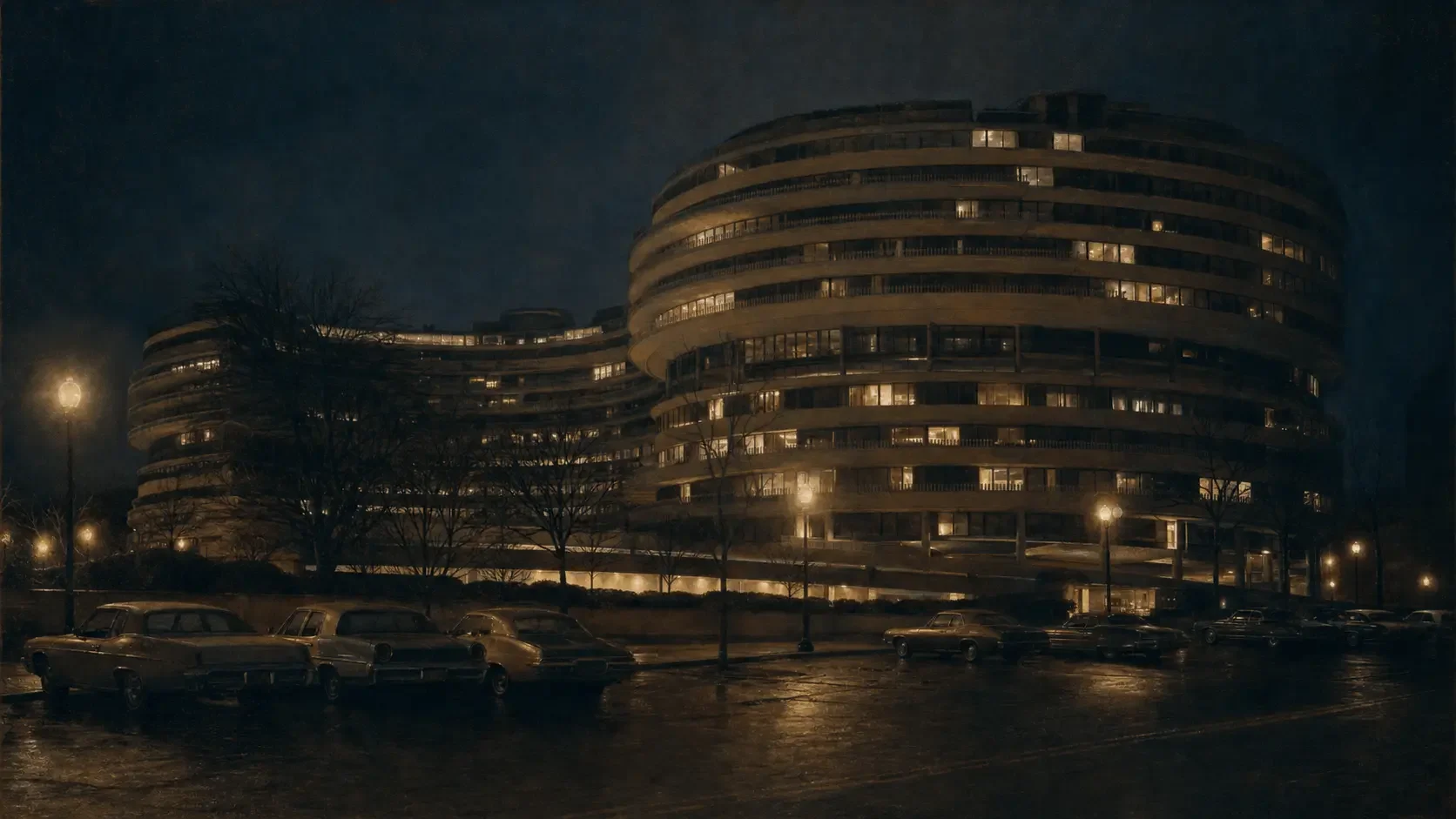
About This Event
The Watergate break-in occurred in the early hours of June 17, 1972, during President Richard Nixon’s reelection campaign. Five men entered the Democratic National Committee headquarters on the sixth floor of the Watergate office complex in Washington, D.C., carrying surveillance equipment, cameras, and burglary tools. The operation grew out of political-intelligence efforts connected to the Committee to Re-Elect the President. It was not the first entry into the DNC offices: surveillance equipment had been installed during an earlier operation in May, and the June intrusion was intended in part to repair or replace that equipment.
The burglary was discovered because Watergate security guard Frank Wills noticed tape placed over a door lock. After he removed it and later found the door taped again, he contacted police. Officers entered the building and arrested James McCord, Bernard Barker, Virgilio González, Eugenio Martínez, and Frank Sturgis inside the DNC offices. Investigators soon found connections between the burglars and people working for Nixon’s reelection organization and associated White House operatives. G. Gordon Liddy and E. Howard Hunt, who had helped organize the operation, were also prosecuted in the Watergate burglary case.
What initially appeared to be a politically motivated burglary became the starting point for a much larger investigation into campaign activities and abuses of presidential power. The FBI investigation, criminal prosecutions, investigative journalism, and the Senate Select Committee on Presidential Campaign Activities gradually exposed attempts to conceal the origins of the operation and obstruct investigations. Testimony and White House recordings became central evidence. The resulting constitutional confrontation reached the Supreme Court in United States v. Nixon, after which Nixon released subpoenaed recordings. Facing impeachment proceedings in the House of Representatives, Nixon resigned the presidency on August 9, 1974.
The importance of the break-in lies less in the physical burglary than in what the investigation revealed about the use of political power and the limits of presidential authority. Watergate strengthened congressional and public scrutiny of executive conduct, contributed to changes in campaign-finance and government-ethics rules, and reinforced the principle that a president could be compelled to comply with judicial process. The episode also left a lasting mark on American political culture, making “Watergate” a shorthand for the broader scandal and influencing public trust in government for years afterward.
The Watergate complex remains the central physical place associated with the break-in, although it continues to function as a residential, hotel, and office development rather than as a dedicated historic site. Visitors seeking a museum interpretation can also see a substantial Watergate exhibition at the Richard Nixon Presidential Library and Museum in Yorba Linda, California, where archival materials and recordings place the burglary within the larger sequence of events that led to Nixon’s resignation.
Last updated August 13, 2026