About This Event
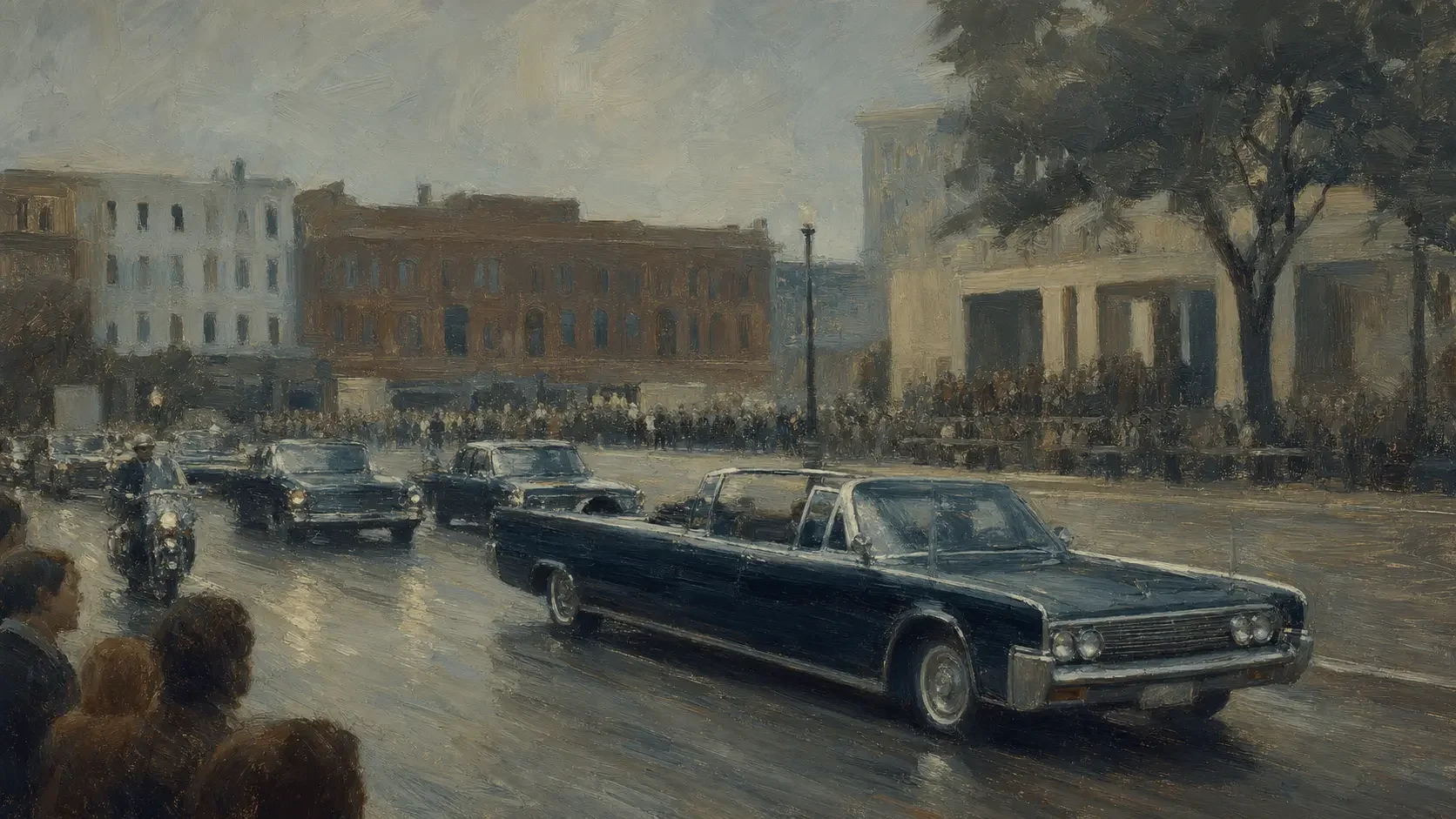
President John F. Kennedy traveled to Texas in November 1963 as his administration looked ahead to the 1964 election and sought to strengthen political support in a state where Democratic divisions had become increasingly visible. On November 22, Kennedy and First Lady Jacqueline Kennedy joined Texas Governor John Connally and his wife, Nellie, in an open limousine for a motorcade from Dallas Love Field to a luncheon at the Trade Mart. At about 12:30 p.m., as the motorcade passed through Dealey Plaza and in front of the Texas School Book Depository, gunfire struck Kennedy and wounded Governor Connally. The presidential limousine rushed to Parkland Memorial Hospital, where Kennedy was pronounced dead.
Attention quickly centered on Lee Harvey Oswald, an employee of the Texas School Book Depository. Evidence connected a rifle found on the building’s sixth floor to Oswald, and police arrested him later that afternoon at the Texas Theatre after the fatal shooting of Dallas police officer J. D. Tippit. Oswald denied killing the president and was charged with Kennedy’s murder, but he never stood trial. On November 24, nightclub owner Jack Ruby shot Oswald in the basement of Dallas police headquarters while television cameras recorded the transfer. Meanwhile, Vice President Lyndon B. Johnson took the presidential oath aboard Air Force One at Love Field before the aircraft returned to Washington, preserving constitutional continuity during a national crisis.
Kennedy’s death produced days of public mourning. His body lay in repose at the White House and in state at the U.S. Capitol before a funeral procession and burial at Arlington National Cemetery on November 25. President Johnson established the Warren Commission to investigate the assassination. Its 1964 report concluded that Oswald fired the shots that killed Kennedy and that the commission found no evidence that Oswald or Ruby was part of a conspiracy. A later House Select Committee on Assassinations agreed that Oswald fired the shots from the Depository but concluded in 1979 that Kennedy was probably killed as the result of a conspiracy, a finding that relied in part on acoustic evidence later challenged by a National Research Council review. No second gunman or wider conspiracy was identified by the committee.
The assassination abruptly ended Kennedy’s presidency and elevated Johnson at a consequential moment in the Cold War, the civil rights struggle, and the expanding U.S. commitment in Vietnam. It also prompted intense examination of presidential protection, federal investigative practices, and the handling of evidence. The event became one of the most closely studied episodes in modern American history, shaped not only by official investigations but also by photographs, films, television coverage, eyewitness testimony, and decades of public debate over unresolved questions.
The physical landscape of the assassination remains unusually accessible. Dealey Plaza preserves the motorcade route and sightlines associated with the shooting, while The Sixth Floor Museum at Dealey Plaza occupies the former Texas School Book Depository and interprets Kennedy’s presidency, assassination, and legacy. In Arlington, Kennedy’s gravesite and Eternal Flame provide a direct connection to the national mourning and funeral that followed the assassination.
Last updated August 13, 2026