About This Event
The Battle of the Alamo was fought during the Texas Revolution, a conflict that grew from disputes between the Mexican government and people in Texas over political authority, federalism, immigration, local autonomy, and other issues. Slavery was also an underlying part of the conflict: many Anglo-American settlers brought enslaved people to Texas, while Mexican policy increasingly restricted the institution. In late 1835, Texian forces captured San Antonio de Béxar and the former Spanish mission known as the Alamo from Mexican troops under General Martín Perfecto de Cos. Rather than abandon the position, a relatively small garrison remained to defend it.
Mexican President and General Antonio López de Santa Anna led an army north and reached San Antonio on February 23, 1836. Roughly 150 defenders initially occupied the Alamo under the divided command of William Barret Travis and James Bowie. Travis issued his famous appeal for reinforcements on February 24, and thirty-two men from Gonzales reached the garrison on March 1. The defenders included Anglo settlers, Tejanos, immigrants from several countries, and others. Noncombatants and enslaved people were also inside the compound. On March 2, while the siege continued, delegates elsewhere in Texas declared independence from Mexico.
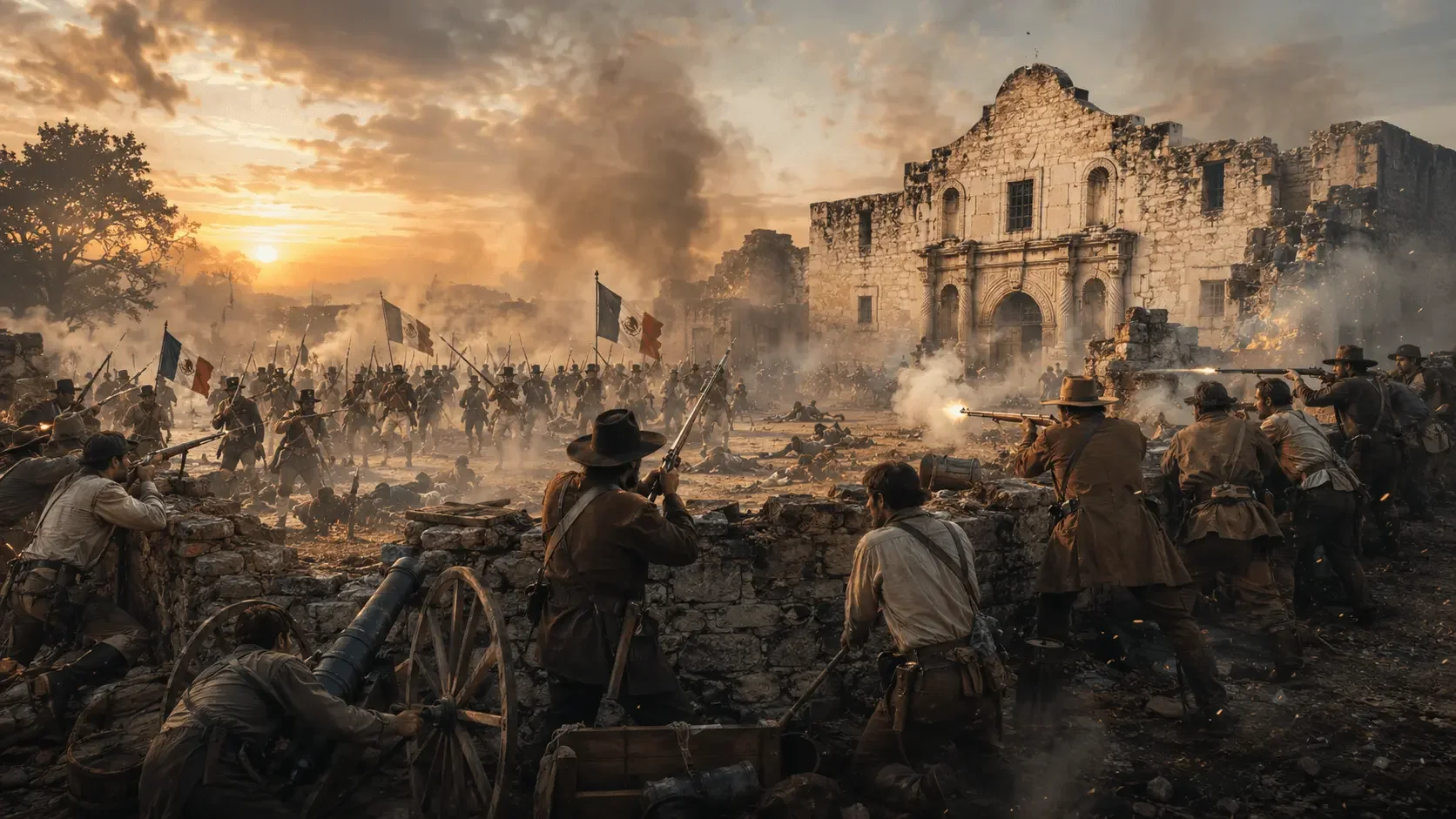
Before dawn on March 6, Santa Anna ordered a coordinated assault. Mexican troops attacked from several directions and eventually breached the defenses. Fighting lasted roughly ninety minutes according to the Alamo’s current historical interpretation. Nearly all of the armed defenders were killed, including Travis, Bowie, and David Crockett. The exact number of defenders remains debated, but responsible modern estimates generally place it around 180 to 200. Several noncombatants survived, including women, children, and enslaved people such as Joe, who had been enslaved by Travis and later provided an important account of the battle.
The Alamo was a Mexican tactical victory, and the Texian military situation became more dangerous in the weeks that followed. Civilians and soldiers retreated eastward during the Runaway Scrape, and the executions of Texian prisoners after Goliad further intensified the conflict. On April 21, 1836, Sam Houston’s army defeated Santa Anna at San Jacinto, where “Remember the Alamo” became part of the Texian rallying cry. Santa Anna was captured, and the immediate campaign ended with agreements that led to the establishment of the Republic of Texas, although Mexico did not accept Texas independence as a settled matter.
The Alamo became a powerful symbol in Texas and American memory, but modern interpretation increasingly places the battle within the broader histories of Tejanos, Mexico, slavery, U.S. migration, and continental expansion. The original battlefield is preserved in downtown San Antonio at The Alamo, where the church, Long Barrack, collections, and archaeological work help visitors understand both the 1836 siege and the site’s earlier life as Mission San Antonio de Valero. Seeing the surviving structures makes clear that the famous battle occurred within a much older Spanish colonial landscape.
Last updated August 13, 2026