





About This Event
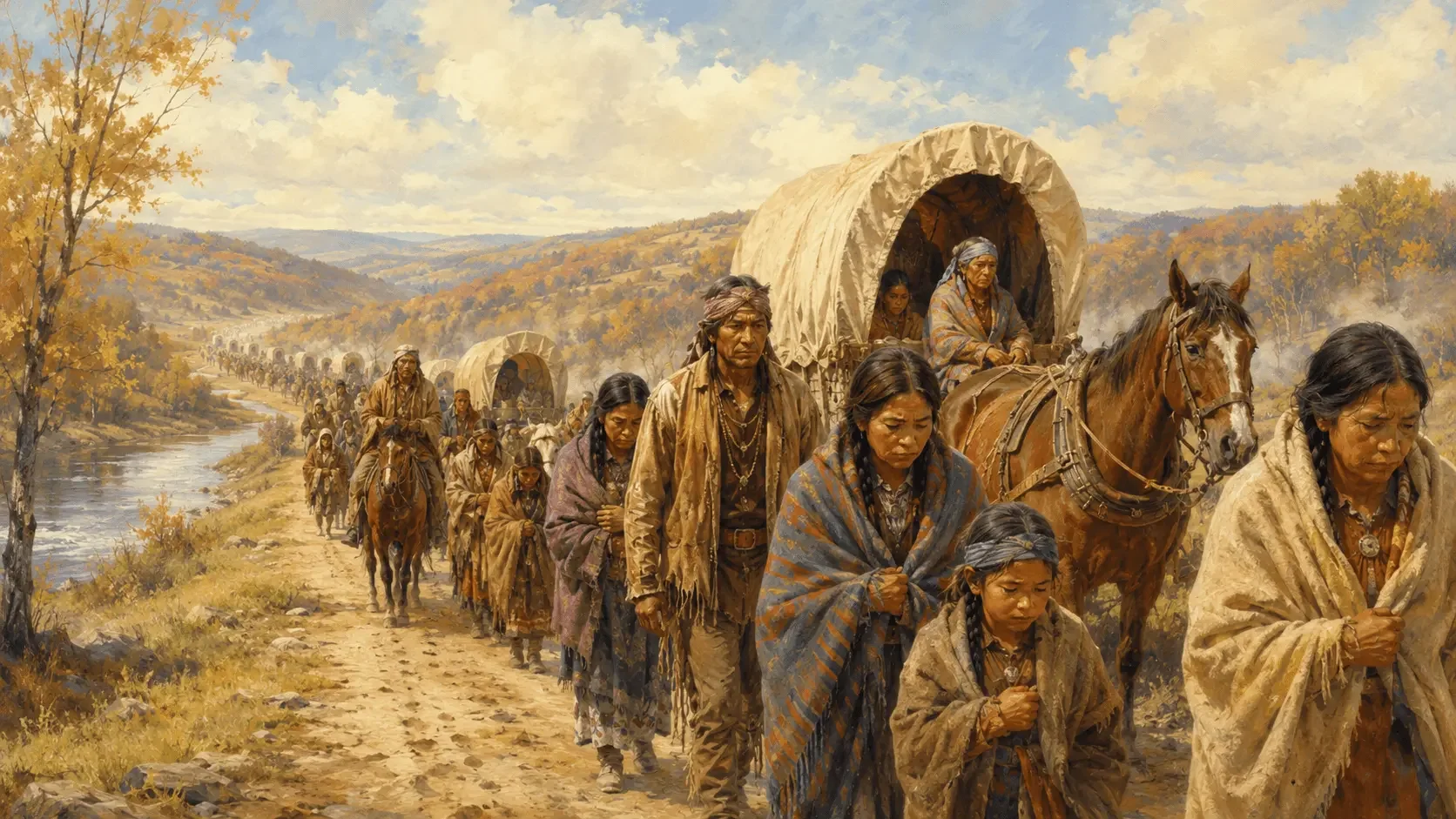
The Trail of Tears most commonly refers to the forced removal of the Cherokee Nation from its homelands in Georgia, Tennessee, North Carolina, and Alabama to Indian Territory in present-day Oklahoma in 1838 and 1839. It grew out of a broader federal policy of Indian removal that intensified after Congress passed the Indian Removal Act in 1830. Southern states, especially Georgia, pressed to take control of Native lands, while Cherokee leaders pursued legal and political resistance. In 1835, a small minority of Cherokee men signed the Treaty of New Echota without authorization from the elected Cherokee government. Most Cherokee people, led politically by Principal Chief John Ross, opposed the treaty, but the U.S. Senate ratified it and set a deadline for removal.
When that deadline passed, President Martin Van Buren ordered the treaty enforced. Beginning in May 1838, U.S. Army troops under Major General Winfield Scott, assisted by state militias, rounded up Cherokee families and confined many of them in temporary stockades. The first government-run removals included travel by water, but disease and deaths led Cherokee leaders to seek greater control over the migration. Most of the remaining people then traveled west in detachments of roughly a thousand, primarily overland. They crossed hundreds of miles through difficult terrain and endured poor food, disease, exposure, exhaustion, and harsh winter weather. Families lost homes, farms, possessions, community institutions, and access to ancestral places as they were forced west.
The human cost was severe, although the exact death toll cannot be established with certainty. Thousands of Cherokee people died during the removal process or from its immediate effects; a contemporary estimate cited by the National Park Service placed the number above 4,000. Survivors rebuilt their national government in Indian Territory, establishing Tahlequah as the Cherokee capital. The removal also deepened political divisions within the Cherokee Nation, including conflict over the Treaty of New Echota. Some Cherokee people had avoided removal or later returned to the Southeast; their descendants became part of the Eastern Band of Cherokee Indians in North Carolina.
The Trail of Tears remains a central example of how federal and state expansion displaced Native nations despite treaty relationships, court cases, petitions, and organized resistance. It was not an isolated episode: Choctaw, Muscogee (Creek), Chickasaw, Seminole, and other Native peoples were also subjected to removal policies during the nineteenth century. For the Cherokee, the 1838–1839 migration represented both a devastating act of dispossession and a story of survival, adaptation, and continued sovereignty. Visitors can encounter this history at New Echota State Historic Site in Georgia, the former Cherokee capital; Red Clay State Historic Park in Tennessee, where the Cherokee government met before removal; and preserved sites and trail segments along the Trail of Tears National Historic Trail, including places near Fort Smith, Arkansas, on the approach to Indian Territory.
Last updated August 13, 2026